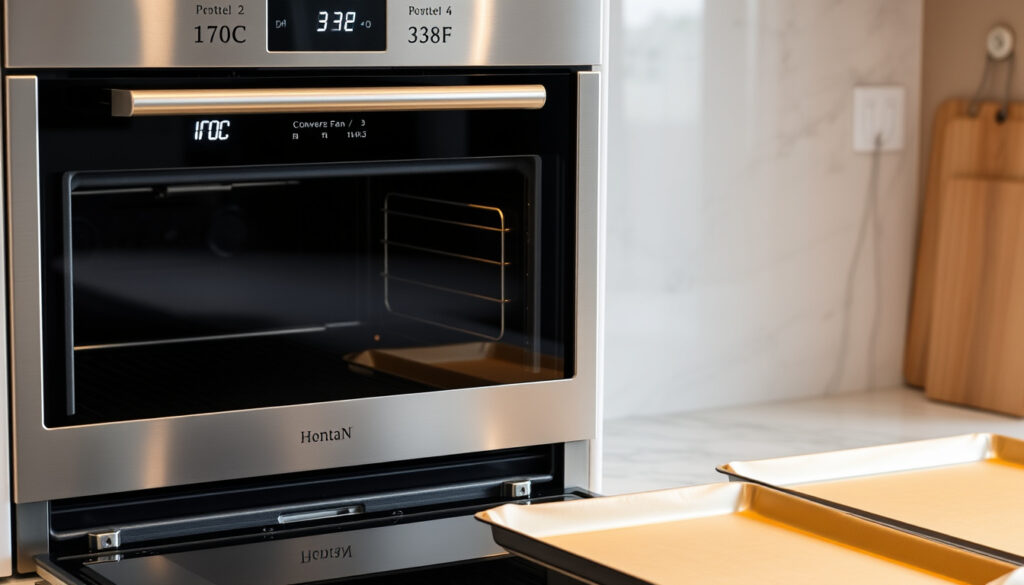
170 C to F: 338°F Oven Conversion Chart + Fan Guide
Few baking disasters frustrate home cooks more than discovering their oven runs hot or cold — and the culprit is often a simple temperature mismatch. Whether you’re following a US recipe that calls for 338°F or adjusting your UK-built fan oven for continental instructions, nailing the right setting matters.
170°C to °F: 338°F · Fan oven equivalent: 150-160°C · Gas mark: 3 · Conventional oven: 325-350°F · Formula: °F = (°C × 9/5) + 32
Quick snapshot
- 170°C = 338°F exactly (Wilprep Kitchen)
- Gas Mark 3 for conventional 170°C (Flawless Food)
- Fan reduction: 20°C lower than conventional (Domestic & General)
- Fan oven reduction varies by model (15-25°C range)
- Minor chart variances: 325°F vs 338°F for same setting
- Gas Mark system predates modern metrication
- Online charts proliferated in the 2010s
- Reference the comparison table for exact equivalents
- Apply the formula for any Celsius-to-Fahrenheit conversion
| Temperature setting | Fahrenheit | Celsius (conventional) | Celsius (fan) | Gas Mark |
|---|---|---|---|---|
| 170°C conventional | 338°F (precise) / 325°F (rounded) | 170°C | 150°C | 3 |
| 150°C fan | 325°F | 170°C | 150°C | 3 |
| 160°C conventional | 320°F | 160°C | 140°C | 3 |
| 180°C conventional | 356°F | 180°C | 160°C | 4 |
| 350°F (US equivalent) | 350°F | 177°C | 157°C | 4 |
What is 170 degrees Celsius in Fahrenheit?
The exact conversion follows a simple formula: multiply the Celsius value by 9/5, then add 32. Working through 170°C step by step: 170 × 1.8 = 306, and 306 + 32 = 338°F (Smeg UK appliance guide). You may encounter 325°F in some recipe charts, which is a rounded approximation that kitchen appliances tolerate well.
Conversion formula
The Celsius-to-Fahrenheit formula is °F = (°C × 9/5) + 32. For the reverse conversion — Fahrenheit to Celsius — subtract 32 from the Fahrenheit value, then multiply by 5/9 (Smeg UK). Memorising this makes every recipe adjustment automatic, whether you’re converting 180°C or 200°C.
Exact calculation
Using the formula gives 338°F as the mathematically precise result for 170°C. Many UK and US recipe sites round this down to 325°F for practical oven settings, a difference that rarely affects baking results but matters when precision is critical, such as when tempering chocolate or proofing yeast (Flawless Food baking blog).
What is 170 C for an oven?
A conventional oven set to 170°C is considered moderately hot — ideal for baked goods that need gentle, even heat such as cakes, brownies, and custards (Domestic & General appliance guide). This temperature sits in the lower-mid range of most domestic ovens, making it a versatile setting for both sweet and savoury recipes.
Conventional vs fan oven
The key difference lies in air circulation: fan ovens move hot air continuously, which means food cooks faster and at a lower temperature to achieve the same result. Reducing the setting by 20°C compensates for this accelerated cooking effect (Which.co.uk consumer review). Without this adjustment, your baked goods may brown too quickly on the outside while remaining underdone inside.
Baking applications
Recipes typically calling for 170°C conventional include sponge cakes (20-25 minutes), macarons for drying stages, and slow-roasted meats starting at higher temperatures before finishing lower. The 325-350°F range (rounded Fahrenheit equivalents) covers most US recipes that align with this Celsius setting.
What’s 170 C in a fan oven?
The standard adjustment when moving from a conventional to a fan oven is to reduce the temperature by 20°C. This means 170°C conventional translates to approximately 150°C in a fan oven (Flawless Food). Some newer fan ovens run slightly hotter or cooler, so the actual sweet spot may fall between 150°C and 155°C.
Fan oven reduction
Fan ovens circulate hot air throughout the cavity, transferring heat to food more efficiently than static heat. This accelerated transfer means recipes that work at 170°C in a conventional oven will finish faster — or burn — at the same temperature in a fan model (Domestic & General). The 20°C reduction accounts for this difference.
Adjusted temperature
When using an air fryer, apply a similar 15-20°C reduction since these appliances operate like compact fan ovens. For 170°C conventional, set your air fryer to 150-155°C and check food 5-10 minutes earlier than the recipe suggests. The more contained space and faster air circulation in air fryers can intensify cooking beyond standard fan oven behaviour.
What gas mark is 170 degrees in a fan oven?
Gas Mark 3 is the UK standard equivalent for 170°C conventional oven settings (Flawless Food). The Gas Mark scale ranges from 1 (cool) to 9 (very hot), with Gas Mark 3 falling in the moderately warm zone alongside 325°F or 160°C in conventional terms.
Gas mark chart
The Gas Mark system was developed for older British gas ovens and persists as a familiar reference for UK home cooks. Gas Mark 3 specifically corresponds to approximately 325°F / 160°C conventional / 140°C fan, making it slightly cooler than 170°C conventional — the precise match is often approximated as Gas Mark 3 in conversion tables (Which.co.uk).
Fan vs conventional
When a recipe specifies Gas Mark 3, set your conventional oven to 160-170°C. For a fan oven, the equivalent drops to 140-150°C. Some detailed charts split the difference with a convection adjustment column, placing 170°C conventional at the upper boundary of Gas Mark 3 or the lower boundary of Gas Mark 4 depending on rounding conventions (Wilprep Kitchen conversion chart).
Is 170 C equal to 350 F?
No — 350°F is actually closer to 177°C, not 170°C. The precise Fahrenheit equivalent of 170°C is 338°F, which is 12 degrees lower than 350°F (Flawless Food). This confusion arises because many recipe charts round to the nearest 25°F increment, making temperatures appear interchangeable when they are not.
Common misconceptions
US and UK recipe traditions sometimes use different rounding conventions. US recipes favour neat 25°F increments (325°F, 350°F, 375°F) for easy mental math, while UK references may use the more precise formula-based values or align with Gas Mark intervals. The result is that 170°C sometimes gets lumped with 350°F in casual recipe swaps, despite the 12°F gap.
Precise equivalents
For baking accuracy, use 338°F when a recipe specifies 170°C. If the recipe calls for 350°F and you need to replicate it in Celsius, set your oven to 177°C conventional or 157°C fan. These small differences matter most in delicate bakes like soufflés, meringues, and bread where precise gluten development or rising is temperature-dependent.
Comparison: Temperature Scales
The table below maps how three major temperature systems correspond across common baking settings.
| Conventional °C | Fahrenheit | Fan °C | Gas Mark | Best for |
|---|---|---|---|---|
| 140°C | 275°F | 120°C | 1 | Keeping warm, slow defrost |
| 150°C | 302°F | 130°C | 2 | Meringues, cheesecakes |
| 160°C | 320°F | 140°C | 3 | Biscuits, pastry cases |
| 170°C | 338°F / 325°F | 150°C | 3 | Cakes, brownies, gentle bakes |
| 180°C | 356°F | 160°C | 4 | Scones, cookies |
| 190°C | 375°F | 170°C | 5 | Roast potatoes, puff pastry |
| 200°C | 400°F | 180°C | 6 | Most roasted meats |
| 220°C | 425°F | 200°C | 7-8 | High-heat roasting, pizza |
The pattern is consistent: every 20°C reduction in a fan oven preserves roughly the same cooking effect as the conventional setting. For Gas Mark, each increment represents approximately 25-30°F, with Gas Mark 3-4 covering the most common baking range.
How to convert Celsius to Fahrenheit
Converting between temperature scales takes seconds once you know the formula. Whether you’re adapting a US recipe for an Australian oven or calculating the right fan oven reduction, the same two calculations cover every scenario.
Step 1: Apply the formula
- For Celsius to Fahrenheit: multiply by 9/5, then add 32
- For Fahrenheit to Celsius: subtract 32, then multiply by 5/9
Step 2: Adjust for oven type
- Fan oven: subtract 20°C from the conventional Celsius setting
- Conventional oven: use the exact conversion result
Step 3: Match to Gas Mark (UK ovens)
- Gas Mark 3 = 160-170°C conventional / 140-150°C fan
- Gas Mark 4 = 180°C conventional / 160°C fan
- Reference a conversion chart if your oven displays Gas Mark only
Step 4: Verify and adjust
- Use an oven thermometer to check actual cavity temperature
- Note that older ovens may run consistently hot or cold by 10-15°C
- Adjust recipe timing 5-10 minutes earlier for fan ovens
Memorise two numbers: 1.8 (multiply for C to F) and 20 (the °C reduction for fan ovens). These two values handle every oven temperature conversion you’ll encounter.
Fan ovens tend to cook food more evenly and quickly because they circulate hot air. Converting recipes from a regular electric oven without a fan to an electric fan oven is easy; reduce the heat by 20°C.
— Flawless Food (Recipe Blog)
These conversions are approximate rounding, and you may find your oven cooks quicker or slower than the standard suggests. Using an oven thermometer is the most reliable way to confirm your oven’s actual performance.
— Skint Chef (Recipe Site)
Upsides
- 170°C covers a wide baking range — cakes, brownies, gentle roasting
- Fan oven reduction is simple: subtract 20°C and go
- Gas Mark 3 aligns closely, making UK-US recipe swapping straightforward
- The C-to-F formula is easy to memorise and apply
Downsides
- Rounding discrepancies (325°F vs 338°F) create confusion across sources
- Fan oven reductions vary by model (15-25°C range)
- Gas Mark is British-specific; irrelevant for US kitchens
- Oven performance varies — charts are guides, not guarantees
UK home cooks following US recipes face a double conversion: Fahrenheit to Celsius, then conventional to fan. Every step adds potential error. Using the right equivalents from the start prevents underbaked sponges and overdone edges.
Related reading: 108 Inches to Feet Conversion
Recipes nearby on the dial, such as 190°C equaling 374°F with fan adjustments to 170°C, follow the same logic outlined in this 190°C to 374°F fan guide.
Frequently asked questions
How do you convert Celsius to Fahrenheit?
Multiply the Celsius temperature by 9/5, then add 32. For example: 170 × 1.8 = 306, and 306 + 32 = 338°F. The reverse uses 5/9 after subtracting 32.
What is 180°C to °F?
180°C converts to 356°F using the formula (180 × 1.8) + 32 = 356°F. In fan ovens, set to 160°C; in Gas Mark, this is approximately Gas Mark 4.
What is the fan oven equivalent of 170°C?
Set your fan oven to 150°C when a recipe calls for 170°C conventional. This 20°C reduction compensates for the faster cooking effect of circulated hot air.
Is 350°F the same as 170°C?
No. 350°F equals approximately 177°C, which is 7°C higher than 170°C. The precise equivalent of 170°C is 338°F — 12 degrees lower than 350°F.
What gas mark is 170°C?
Gas Mark 3 is the closest equivalent for a conventional oven set to 170°C. Some detailed charts place it at the upper end of Gas Mark 3 or the lower boundary of Gas Mark 4.
How do I convert 170°C to Fahrenheit for an air fryer?
Set your air fryer to 150-155°C. Air fryers operate similarly to fan ovens, so apply the same 15-20°C reduction from the conventional temperature setting.
What are common oven temperature conversions?
Key benchmarks: 150°C = 302°F / Gas 2; 170°C = 338°F / Gas 3; 180°C = 356°F / Gas 4; 200°C = 400°F / Gas 6; 220°C = 425°F / Gas 7-8.
For UK bakers following American recipes, the path from 338°F to the right oven setting requires two quick steps: convert the Fahrenheit to Celsius, then apply the fan oven reduction if needed. Most modern fan ovens handle the adjustment automatically via a convection setting, but knowing the 20°C rule gives you control when adjusting old recipes.
More related posts
 Sarah Levy: Husband, Sobriety, and Schitt’s Creek Role
 Canada Passport Visa Free Countries 2026: 182 Destinations Ranked
 Connor McDavid: Wife, Stats & Gretzky Comparison
 Wallace Shawn Movies and TV Shows: Full Career Guide
 RBC Insurance Phone Number: Contacts for Auto, Claims & More
 Apartments for Sale Vancouver – 2025 Buyer’s Market Guide
 Jake Paul vs Tank: Fight Cancelled Over Davis Allegations
 Obi-Wan Kenobi: Biography, Death & Character Analysis
